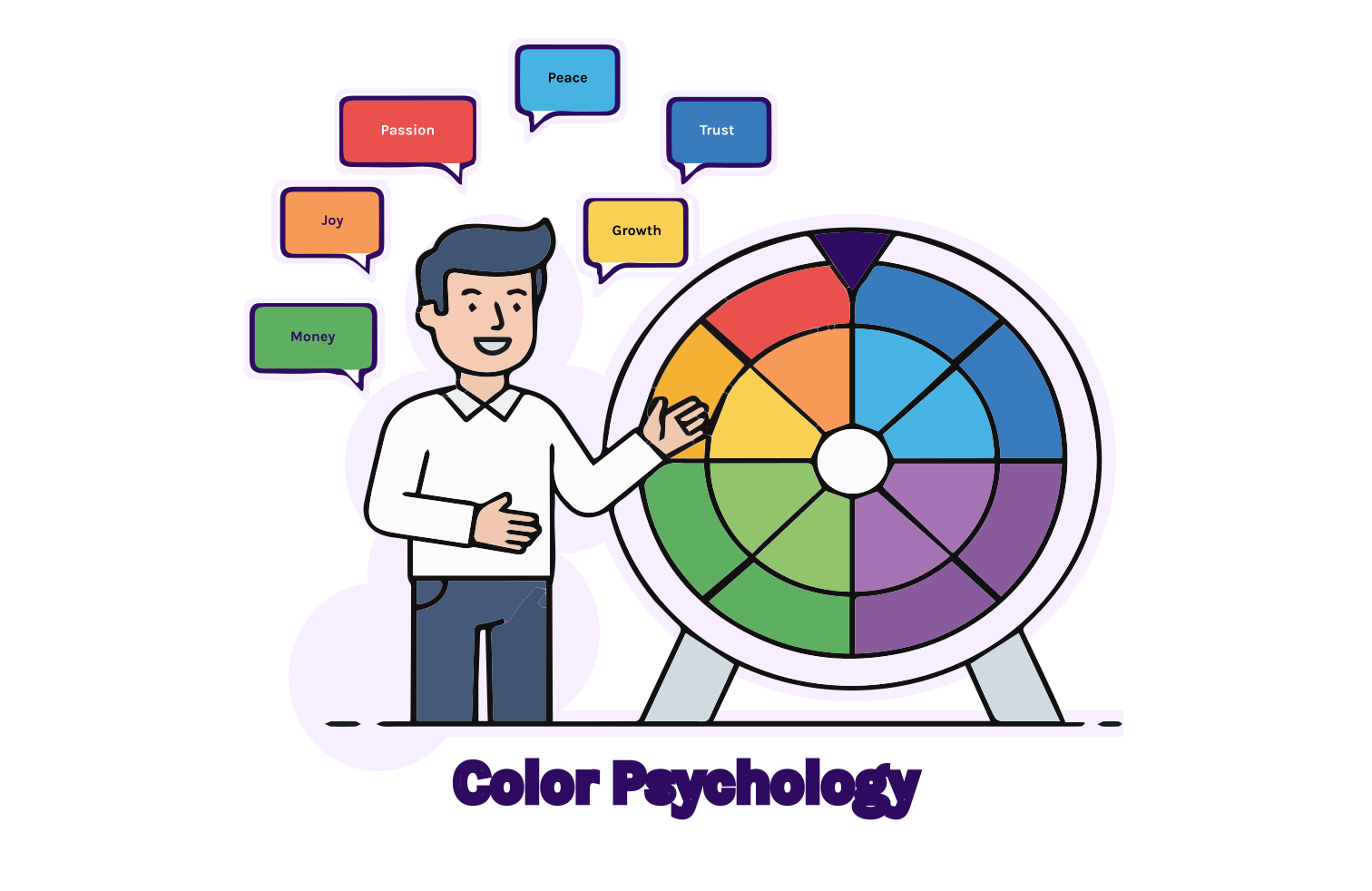
Summary
“Color psychology” has permeated the spheres of marketing, interior design, and self-help literature, often presented as a collection of universal laws governing human behavior and emotion. This analysis posits that the vast majority of these claims lack a rigorous scientific foundation, functioning instead as a system of culturally learned associations and oversimplified heuristics. By examining the disparity between popular beliefs and empirical psychological research, it becomes evident that the term "psychology" is frequently misapplied to describe aesthetic preferences and socialized symbolic systems. The persistence of these myths serves as a testament to the human desire for deterministic rules in creative decision-making, yet the evidence suggests that color perception is a highly individualized, context-dependent, and culturally relative phenomenon.1 2 3
1. Introduction: What People Mean by “Color Psychology”
In contemporary discourse, the term "color psychology" has been appropriated by the design and marketing industries to describe a purportedly scientific method for influencing consumer behavior through the strategic application of hue. Popular belief systems surrounding this topic typically rely on the assumption that specific colors possess inherent emotional properties—for instance, that red inevitably triggers excitement or that blue fundamentally induces trust.4 These claims are frequently disseminated through simplified infographics, blog posts, and "expert" guides that promise one-size-fits-all solutions for branding and environmental design. Proponents of this view often suggest that by simply changing the color of a "Call to Action/CTA" button or a retail space’s walls, one can reliably elicit predictable psychological states in a broad population.2 4 5 6
However, the application of the label "psychology" in this context is frequently a misnomer. While legitimate psychological research does investigate how color affects human perception and behavior, the "color psychology" prevalent in the popular sphere is often a form of pseudo-psychology characterized by overgeneralization and a lack of nuance.2 This misuse of terminology creates an illusion of scientific authority, suggesting that the symbolic meanings humans attribute to colors are as fixed as biological reflexes. In reality, what many marketers and designers refer to as "color psychology" is a collection of anecdotal evidence and historically established social conventions that lack the replicability required of true psychological laws.1 2 6 6
The presentation of these ideas in the self-help and empowerment industries further complicates the landscape. Color is often framed as a tool for personal control, where wearing a specific shade is claimed to "boost confidence" or "uplift mood" as if the color itself were a pharmacological agent. 5 These claims often rely on the "fluency heuristic," where the ease of understanding a 1:1 color-to-emotion mapping makes the concept more believable to the layperson, regardless of its empirical validity.6 Here through this report, I am seeking to deconstruct these claims by contrasting the anecdotal "laws" of color symbolism with the complex, context-bound reality revealed by rigorous scientific inquiry.9
2. Psychology vs. Association Systems: A Categorical Distinction
To properly evaluate the claims of color psychology, we must distinguish between the scientific study of psychology and the social construct of association systems. Psychology, as a discipline, is concerned with the mechanisms of human cognition, perception, and behavior through the lens of neuroscience, biology, and experimental validation.1 When psychologists study color, they often focus on low-level physiological responses, such as the pupillary light reflex or the neural pathways involved in processing different wavelengths. These are biological constants. In contrast, "color association" refers to the cognitive links humans form between colors and specific concepts, objects, or experiences.1 10 11
The fundamental error in the popular view is the assumption that these associations are universal psychological laws. An association is a learned response, often forged through repeated exposure to a specific cultural context. For example, the association of the color green with "nature" or "health" is a product of environmental observation, while the association of green with "money" is a specific financial convention in the United States.13 Neither of these is an inherent property of the color green itself. If an individual grew up in a desert environment where green was associated with poisonous flora, their "psychological" reaction to green would be one of caution rather than relaxation, directly contradicting the "universal" rules found in design literature.13 14 3
Physiological vs. Symbolic Responses
|
Response Type |
Mechanism |
Examples |
Scientific Basis |
|---|---|---|---|
|
Physiological |
Wavelength processing in the retina and visual cortex. |
Pupil dilation, heart rate changes (subtle), alertness to bright light. |
High (Biology/Physics) |
|
Cognitive/Symbolic |
Learned associations through culture and memory. |
Red for "love," Blue for "trust," White for "purity." |
Moderate to Low (Sociology/History) |
|
Contextual |
Interaction between environmental cues and internal state. |
Red as "danger" in traffic vs. "passion" in a bedroom. |
High (Behavioral Science) |
Research indicates that while certain colors can indeed trigger subtle physiological shifts—such as longer wavelengths (red) potentially being more arousing than shorter wavelengths (blue)—these effects are often fleeting and easily overridden by higher-order cognitive processing.15 Furthermore, the complexity of the human brain allows for "dualistic" responses, where a single color can carry multiple, even contradictory, meanings simultaneously. Red can signify both a "life-saving" ambulance and a "life-ending" warning sign.12 This flexibility proves that color meaning is not "hard-wired" but is instead a dynamic, communicative tool that depends on the situational framework in which it is perceived.6 12 15 16 17
3. The Lack of Scientific Evidence: Replication and Generalization
One of the most significant indictments of popular color psychology is the pervasive absence of consistent, replicable scientific studies. Many of the most famous "laws" in the field are derived from small-scale experiments that failed when subjected to the rigors of the "replication crisis" in modern psychology.2 For decades, the design community has cited studies claiming that red impairs performance on intellectual tasks by inducing avoidance motivation. However, large-scale replications, such as those targeting the work of Lichtenfeld and Elliot, have frequently found no significant effect on verbal reasoning or general knowledge test scores.2 18
A primary problem in color research is the "overgeneralization" of findings. A study that shows a specific shade of red might increase grip strength in a laboratory setting does not mean that a red logo will increase sales in a retail environment.6 Furthermore, many "studies" cited by design gurus are misinterpreted or oversimplified to fit a marketing narrative. For instance, the claim that red "boosts conversion rates by 30%" is often a result of deceptive math or a specific contrast effect rather than the inherent "power" of the color red itself.2 When the impact of a color change is actually isolated from other variables like layout, typography, and contrast, the actual psychological effect of the hue is often found to be statistically negligible.2 6
Methodological Weaknesses in Extant Color Research
The field of color psychology is fraught with methodological inconsistencies that make broad conclusions difficult to sustain. Researchers often fail to account for the three primary properties of color: hue, lightness, and chroma (saturation). Without controlling for these, it is impossible to know if a participant reacted to the "redness" of a stimulus or its "brightness".17 15 19
|
Methodological Flaw |
Description |
Impact on Findings |
|---|---|---|
|
Lack of Spectral Specification |
Failure ti defube tge exact CIE L*a*b* or RGB values used. |
Results cannot be reliably compared across different studies. |
|
Small Sample Sizes |
Studies utilizing fewer than 50 participants. |
High risk of Type I and Type II errors; inflated effect sizes. |
|
Absence of Blindness |
Experimenters knowing the hypothesis and color conditions. |
Subtle biases can influence participant responses. |
|
Environmental Confounding |
Failing to control for ambient lighting and background colors. |
Perceived color changes based on "chromatic adaptation." |
The "media-friendly" nature of color research also contributes to a skewed public perception. Provocative and simplified results are more likely to be featured in mainstream news outlets and design blogs, creating a feedback loop where non-replicable or fringe studies are treated as established consensus.17 Scientists have noted that while color certainly plays a role in perception, the field is in a "nascent stage," and most popular conclusions about its real-world application are premature.17
4. Color as Contextual, Not inherent
The fundamental flaw in the "color psychology wheel" is the assumption that colors carry fixed emotional properties. In reality, a color's meaning is entirely dependent on the context and the situation in which it is encountered. This is best explained by "Color-in-Context Theory," which suggests that the psychological meaning and subsequent effect of a color are fundamentally situational.12 For example, the color red is not "naturally" aggressive; its interpretation shifts from a signal of romantic attraction in a dating profile to a signal of failure on a graded exam.16 15 18
The Contextual Spectrum of Red
The color red provides perhaps the most illustrative example of how a single hue can evoke contradictory responses based on the surrounding environment. In a "mating context," red is associated with sexual desire and attractiveness, likely rooted in biological signals of blood flow and health.6 However, in an "achievement context," the same red is associated with danger and the possibility of failure, potentially leading to avoidance behavior and impaired performance.2 16 2 18
|
Context |
Dominant Meaning |
Behavioral Trigger |
Example |
|---|---|---|---|
|
Traffic/Safety |
Danger / Stop |
Caution/Inhibition |
Stop signs, sirens. |
|
Branding |
Branding Energy / Excitement |
Engagement/Action |
Coca-Cola, ESPN. |
|
Social/Romance |
Passion / Attraction |
Approach motivation |
Red dresses, Valentine's Day. |
|
Academic |
Error / Failure |
Avoidance motivation |
Red pen markings on a test. |
|
Ritual/Tradition |
Good Luck / Joy |
Celebration |
Chinese New Year decorations. |
This fluidity extends across all hues. Blue is often described as "calm" and "soothing" because of its link to the sky and ocean. Yet, blue on a piece of meat signals spoilage and rot, triggering a visceral "disgust" response rather than a sense of peace.15 This indicates that our brains are not reacting to wavelengths in a vacuum but are constantly synthesizing visual data with situational knowledge to produce a behavioral outcome.11 Thus, designing for a "mood" without considering the functional context of the space or product is a strategy destined for inconsistency.12 17
5. Cultural Variability in Color Meaning
The claim that certain color responses are universal is easily debunked by the vast cross-cultural variations in color symbolism. Different cultures have assigned diametrically opposed meanings to the same colors throughout history, often rooted in their unique geography, religion, and social traditions.14 For instance, while white is the universal color for purity and weddings in Western societies, it is the primary color of mourning and funerals in many Eastern cultures, including China and parts of India.13 21 22
Cultural differences also manifest in the very way humans categorize colors. The "World Color Survey" and subsequent linguistic research have shown that some cultures do not even have distinct words for colors that Westerners consider fundamental. The concept of "Grue" (a single term for both green and blue) exists in many tropical languages, possibly influenced by environmental factors such as high ultraviolet radiation affects ocular lens yellowing.24 These linguistic differences are not mere semantics; they influence how people perceive and remember visual information.25
Cross-Cultural Contradictions in Color Symbolism
|
Color |
Western Culture |
Eastern Culture |
Other Regional Contexts |
|---|---|---|---|
|
White |
Purity, Peace, Simplicity. |
Mourning, Death (China/Japan). |
Rebirth/New Beginnings (General). |
|
Yellow |
Happiness, Optimism. |
Sacred/Knowledge (India). |
Mourning (Egypt), Jealousy (Germany). |
|
Red |
Danger, Passion, Love. |
Good Luck, Prosperity (China). |
Mourning (South Africa). |
|
Green |
Nature, Envy, Health. |
Religious significance (Middle East). |
Danger/Warning (South Africa). |
|
Purple |
Royalty, Luxury, Wealth. |
Mourning (Thailand/Brazil) |
Spirituality/Mystery (General). |
The presence of these contradictions makes it impossible for any universal color psychology chart to be accurate. A brand that uses yellow to signify "cheerfulness" may be perceived as offensive or grieving in Egypt, while a medical app using white for "cleanliness" may evoke feelings of loss for a Japanese user.13 Consequently, global design strategies must move away from the myth of universal color meanings and instead focus on deep-dive cultural analysis to avoid communicative failures.6 14
6. Personal Experience and Individual Interpretation
Even within a single culture, individuals develop unique and often intense emotional responses to colors
based on their lived experiences. These personal factors—memory, trauma, nostalgia, and individual
personality—often override any general cultural or psychological "rules".1
For example, if an individual’s happiest memories are associated with a yellow-painted kitchen from
their childhood, they will continue to perceive yellow as "comforting," even if the rest of their
society uses it for "warning" or "caution".1 7 27
Recent research by Schloss et al. (2015) has highlighted that color preferences are largely driven by
the "valence of color-associated objects." This means that we do not like a color because of its
wavelength, but because we like the things that usually have that color.7
If a person loves the ocean, they are more likely to prefer blue; if they have a phobia of snakes and
common snakes in their area are brown, they may develop a visceral dislike for that shade.28
Factors Overriding General Color Rules
- Trauma and Phobias: A negative event associated with a specific color can create a lifelong "conditioned response" of fear or anxiety.1 7
- Nostalgia: Colors associated with significant life milestones (weddings, births, specific eras) can trigger powerful, idiosyncratic moods.1 29 30
- Biological Differences: Color blindness (affecting 8% of males) and age-related changes in vision mean that different people are literally seeing different colors, making "universal" triggers impossible to standardize.4 7 31
- Neurodiversity: ndividuals on the autism spectrum or those with sensory processing sensitivities may find high-saturation colors overwhelming or painful rather than "energizing".27 32
The role of lived experience proves that human reactions to color are not static, biological scripts but are part of a complex, evolving personal narrative. Two people can look at the exact same hexadecimal color and have completely opposite emotional reactions, rendering the idea of "color as control" functionally useless in a diverse world.3 30
7. Case Study: Red and Blue as Overused Examples
Red and blue serve as the primary "proof points" for color psychology gurus, yet they provide the most compelling evidence for its internal contradictions. In the popular imagination, red is the color of power, passion, and excitement. It is famously used by brands like Coca-Cola and ESPN to command attention and stimulate energy.4 However, red is also the color of blood, war, and failure. The 2004 Olympics study showed that athletes in red won more matches, which was attributed to a link between red and perceived dominance. Yet, the same color used in a classroom can lower student performance because it is associated with the "danger" of being wrong.6 16 6
Blue is almost universally marketed as the color of "trust," "reliability," and "calmness." It is the most preferred color globally and is the "safe" choice for corporate entities like banks and tech giants (e.g., Chase, American Express, IBM).4 However, blue also symbolizes sadness ("feeling blue"), coldness, and detachment. In UI design, while blue is calming, it can also feel sterile and analytical, potentially creating a "clinical" distance between the brand and the user.9 33 34 11
The Duality of Red and Blue in Popular Branding
|
Brand |
Color |
Intended Association |
Potential Contradiction |
|---|---|---|---|
|
Coca-Cola |
Red |
Excitement, Boldness, Energy. |
Aggression, Obesity/Health Warning. |
|
IBM/Intel |
Blue |
Competence, Reliability, Intelligence. |
Boredom, Coldness, Lack of Creativity. |
|
Red Bull |
Red/Blue |
Energy, Vitality, Competition. |
Risk-taking, Heart Rate elevation. |
|
PayPal |
Blue |
Security, Safety, Trust. |
Impersonal, Financial clinicality. |
These examples expose a critical flaw: the "meaning" of the color is often assigned after the fact to match the brand’s existing reputation. Coca-Cola's red is iconic not because red is "magically" exciting, but because Coca-Cola has spent billions of dollars and over a century teaching the world to associate their specific red with holiday cheer and refreshment.6 If the color itself were the driver, any brand using red would automatically be seen as bold and energetic, which is demonstrably false.34
8. Why Color Psychology Persists
Despite its lack of scientific foundation, color psychology persists as a multibillion-dollar sub-industry within marketing and design. This persistence is largely due to the "marketing convenience" of having a simple set of rules to present to clients. It is much easier for an agency to justify a specific palette by claiming it "psychologically primes the customer for trust" than it is to admit the choice was based on aesthetic preference or trend-following.1 3 Authority bias and the "echo chamber" effect of the internet also play significant roles. Once a claim like "green makes users envious" is published on a high-traffic blog, it is repeated by hundreds of other sites, eventually becoming a "fact" through sheer repetition.2 Search engines like Google often reward these simplified, listicle-style articles because they match common user queries, further incentivizing the production of pseudoscientific content over rigorous research.2
The Mechanics of Persistence
- Fluency Heuristic: Simple 1:1 mappings (Red = Love) are easier to process and remember than complex contextual theories, making them more appealing to busy professionals.6
- Creative Decision-Making: For designers facing the "paradox of choice" with millions of possible colors, color psychology wheels provide a comforting, if false, set of boundaries to guide their work.3 6
- Deceptive Math: Marketing "gurus" often use misleading statistics—such as a "30% conversion boost"—to sell their services. In reality, these gains are often within the margin of error or due to other UX changes.2
- Anthropological Appeal: Humans have a deep-seated desire to find universal symbols and "secret languages" in nature, making the idea of a hidden "psychological code" for colors naturally seductive.6 27
9. Color in Design: A Practical, Evidence-Based Approach
If "color psychology" is largely a myth, how should designers and marketers approach color? The most effective, evidence-based strategy focuses on color as a functional tool for hierarchy, contrast, and accessibility, rather than a psychological trigger.31 Instead of assuming how a user feels, designers should focus on how a user acts and whether they can see the information provided.35 36
Contrast is the most critical element of functional color design. The human eye is naturally drawn to the point of highest contrast in a composition. Using a bright, contrasting color for a "Call to Action" button works not because the color is "motivating," but because it stands out against the background, clarifying the visual hierarchy2 31 In this context, a red button might outperform a green one simply because red provides a higher contrast ratio against the specific background, not because of "redness" itself.2 37
Evidence-Based Design Principles
|
Principle |
Objective |
Strategy |
|---|---|---|
|
Contrast Ratio |
Ensure legibility and focus. |
Follow WCAG standards (4.5 : 1 for normal text) |
|
Visual Hierarchy |
Guide the user’s eye. |
Use bold, high-saturation colors for primary actions. |
|
Accessibility |
Inclusion of all vision types. |
Do not rely on color alone to convey meaning (use icons/text). |
|
A/B Testing |
Validate assumptions with data. |
Test multiple color options with real users in context. |
|
Consistency |
Build brand recall. |
Use a unified palette across all touchpoints to reinforce identity. |
Designers must also prioritize "usability testing" over abstract rules. Instead of following a chart that says "orange promotes creativity," a design team should create prototypes with different color schemes and measure task completion times and user errors. This "behavioral" approach provides actual evidence of how an audience interacts with color in the specific context of the product.1 3 37
10. Reframing Color: From Pseudo-Science to Design Language
Moving away from the deterministic claims of color psychology allows for a more sophisticated reframing
of color as a visual language.
Color is a form of communication, not an "emotion control" switch. It works through a complex system of
semiotics—where colors act as symbols that represent ideas, but those ideas are subject to the same
rules of grammar, context, and evolution as any spoken language.3
6 14
When we use color intentionally, we are "speaking" to our audience. For example, a luxury brand might
use a palette of black, gold, and white. This choice doesn't "hack" the brain into feeling wealthy; it
signals to the viewer that the brand aligns with the historical visual codes of "high-end"
products.12 The "meaning" of these colors is a shared agreement
between the brand and the culture, not a biological imperative.27
38
Communication-Based Color Selection
- Audience-Centric Research: Determine what specific colors mean to your target demographic, considering their age, culture, and industry.6
- Appropriateness vs. Emotion: Focus on whether a color "fits" the product category. Research shows that consumers value "color-brand personality congruence" over specific emotional triggers.4 6 34
- Environmental Thinking: Consider the entire "environment" the color creates. A brand identity is formed by the combination of hues, tints, and shades, along with typography and name, not a single "magic" color.3 6
- Descriptive vs. Abstract: Use colors that describe the product's function (e.g., green for an organic salad) rather than abstract psychological theories.4 13
11. Conclusion: Why Calling It “Psychology” Does More Harm Than Good
In conclusion, the practice of branding "color psychology" as a hard science is a distortion that risks misleading designers, researchers, and users alike. By oversimplifying the complex relationship between the human mind and the visual spectrum, proponents of these myths encourage a "lazy" approach to design that ignores the critical roles of context, culture, and individual agency.2 3 The misuse of scientific language creates a false sense of certainty, leading to "accessible" designs that may actually be illegible or culturally offensive to significant portions of the population.2 6 14
A call for more responsible color discussion is necessary. We must transition from deterministic claims—"red makes you hungry"—to a more nuanced, contextual, and evidence-based design discourse.2 3 Designers and marketers should embrace color as a powerful tool for clarity and communication while remaining humble about our ability to "predict" or "control" the human emotional experience. The beauty of color lies not in a secret psychological code, but in its ability to be interpreted differently by every human being on the planet.1 15 28
Works Cited
- The truth about color psychology in design: Is it worth the hype? | by Naif Ekkeri - Medium, accessed December, 2025, https://medium.com/design-bootcamp/the-truth-about-color-psychology-in-design-is-it-worth-the-hype-2c55a8a7e628 ››
- You Should Reconsider Color Psychology | Behavioral Design ..., accessed December, 2025, https://www.behavioraldesign.academy/blog/reconsider-color-psychology ››
- The Problem With Color Psychology - The Design Lab, accessed December 20, 2025, https://nicoleyangdesign.com/2021/04/16/the-problem-with-color-psychology/ ››
- The Truth About Color Psychology in Marketing - Paperkite, accessed December, 2025, https://www.hellopaperkite.com/2021/09/27/the-truth-about-color-psychology-in-marketing ››
- How Color Psychology Affects Moods, Feelings, and Behaviors - Verywell Mind, accessed December, 2025, https://www.verywellmind.com/color-psychology-2795824 ››
- Branding color psychology is mostly (but not entirely) bullshit - How ..., accessed December, 2025, https://howbrandsarebuilt.com/branding-color-psychology/ ››
- Color Psychology: Exploring Hues for Emotions & Behavior - Gel Press, accessed December, 2025, https://gelpress.com/blogs/art-and-inspiration/color-psychology ››
- Colour psychology and physiology – Colour Theory: Understanding and Working with Colour - RMIT Open Press, accessed December, 2025, https://rmit.pressbooks.pub/colourtheory1/chapter/colour-psychology-physiology/ ››
- Color Psychology: How Do Colors Affect Mood & Emotions?, accessed December, 2025, https://londonimageinstitute.com/how-to-empower-yourself-with-color-psychology/ ››
- Handbook of Color Psychology Edited by Andrew J. Elliot, Mark D. Fairchild, accessed December, 2025, https://assets.cambridge.org/97811070/43237/frontmatter/9781107043237_frontmatter.pdf ››
- Color Associations: The Psychology and Meaning Behind Colors - UX 4Sight, accessed December, 2025, https://ux4sight.com/blog/designers-guide-to-color-associations ››
- (PDF) THE PSYCHOLOGICAL MEANING OF COLOR IN DESIGN: A ..., accessed December, 2025, https://www.researchgate.net/publication/391197119_THE_PSYCHOLOGICAL_MEANING_OF_COLOR_IN_DESIGN_A_SEMANTIC_REVIEW ››
- A guide to color meaning | Adobe, accessed December, 2025, https://www.adobe.com/creativecloud/design/discover/color-meaning.html ››
- How color can impact user behavior, context, and culture | Bootcamp - Medium, accessed December, 2025, https://medium.com/design-bootcamp/ux-blueprint-11-how-color-can-impact-user-behavior-context-and-culture-460118ff9e26 ››
- Color and psychological functioning: a review of theoretical and empirical work - PMC, accessed December, 2025, https://pmc.ncbi.nlm.nih.gov/articles/PMC4383146/ ››
- Psychology of the Color Red - Verywell Mind, accessed December, 2025, https://www.verywellmind.com/the-color-psychology-of-red-2795821 ››
- Color and psychological functioning: a review of ... - Frontiers, accessed December, 2025, https://www.frontiersin.org/journals/psychology/articles/10.3389/fpsyg.2015.00368/full ››
- Processing the Word Red and Intellectual Performance: Four ..., accessed December, 2025, https://online.ucpress.edu/collabra/article/6/1/3/113047/Processing-the-Word-Red-and-Intellectual ››
- Text-to-image models reveal specific color-emotion associations - Frontiers, accessed December, 2025, https://www.frontiersin.org/journals/psychology/articles/10.3389/fpsyg.2025.1593928/full ››
- Color and Psychological Functioning: The Effect of Red on Performance Attainment, accessed December, 2025, https://www.researchgate.net/publication/6482505_Color_and_psychological_functioning_The_effect_of_red_on_performance_attainment ››
- "The Diversity of Color: an Analysis of Cross-cultural Color Symbolism" by Erica L. Bradfield, accessed December, 2025, https://digitalcommons.andrews.edu/honors/90/ ››
- An exploration into colour symbolism as used by different cultures and religions - NCCA Animation Archive - Bournemouth University, accessed December, 2025, https://animationarchive.bournemouth.ac.uk/wp-content/uploads/2023/12/LauraDillowayInnovations.pdf ››
- Comparative (Cross-cultural) Color Preference and Its Structure, accessed December, 2025, https://sites.socsci.uci.edu/~kjameson/ECST/Saito_ComparativeCrossCulturalColorPreferenceAndItsStructure.pdf ››
- Color categorization across cultures (Chapter 12) - Handbook of Color Psychology, accessed December, 2025, https://www.cambridge.org/core/books/handbook-of-color-psychology/color-categorization-across-cultures/F4D7C54BE57673C63FC036EB90AB25E8 ››
- Is Color Perception a Universal Human Experience? - The Perspective, accessed December, 2025, https://www.theperspective.com/debates/living/color-perception-a-universal-experience ››
- The Psychology of Color: How the Shades Around You Impact Your Emotions, accessed December, 2025, https://insightspsychology.org/psychology-of-color-emotional-impact/ ››
- Color Psychology: A Guide to the Meaning of Colors | Skillshare Blog, accessed December, 2025, https://www.skillshare.com/en/blog/color-psychology-a-guide-to-the-meaning-of-colors/ ››
- (PDF) Color Preferences Are Not Universal - ResearchGate, accessed December, 2025, https://www.researchgate.net/publication/233410106_Color_Preferences_Are_Not_Universal ››
- Color psychology - Color Navigator Blog, accessed December, 2025, https://blog.colornavigator.net/color-psychology ››
- Lived Experience of Academic Librarians of Color | Swanson | College & Research Libraries, accessed December, 2025, https://crl.acrl.org/index.php/crl/article/view/16850/19187 ››
- Design for All: The importance of Color Contrast in Accessibility | by Ux&You | Medium, accessed December, 2025, https://medium.com/@uxandyouti/design-for-all-the-importance-of-color-contrast-in-accessibility-399ad9b557af ››
- Emotionality of Colors: An Implicit Link between Red and Dominance - Frontiers, accessed December, 2025, https://www.frontiersin.org/journals/psychology/articles/10.3389/fpsyg.2017.00317/full ››
- Color Psychology and Marketing: Does Color Really Affect Our Perceptions? - Noissue, accessed December, 2025, https://noissue.co/blog/blog-color-psychology-myth-or-marketing-tool/ ››
- The Psychology of Color in Marketing: How Visual Elements Affect Consumer Perception, accessed December, 2025, https://www.jmsr-online.com/article/the-psychology-of-color-in-marketing-how-visual-elements-affect-consumer-perception-142/ ››
- Accessibility | Color & Type - UCLA Brand Guidelines, accessed December, 2025, https://brand.ucla.edu/fundamentals/accessibility/color-type ››
- Accessibility for visual designers - Digital.gov, accessed December, 2025, https://digital.gov/guides/accessibility-for-teams/visual-design ››
- Contrast Design Principle: Guide to Visual Clarity | Ramotion Agency, accessed December, 2025, https://www.ramotion.com/blog/contrast-principle-in-design/ ››
- Understanding the Meaning of Colors in Color Psychology, accessed December, 2025, https://www.empower-yourself-with-color-psychology.com/meaning-of-colors.html ››
Important
Hover to reveal text (if you're on desktop) - click on smartphone to expand text



Notes
Recommendations
These are recommendations for writings outside of this blog and website.
The Personalized Education Investment Prospectus: A Quantitative Framework for Determining College Worth
A framework to help you determine if college is your path considering factors such as finances, emotional state and other factors
Explore Framework >>Ads as security threats and safest browsers for vulnerable users
The USA government has classified (some) online advertising methods as a cybersecurity threat - Here, you'll see some tips and recommendations on what to do next to protect yourself.
See more on cybersecurity >>