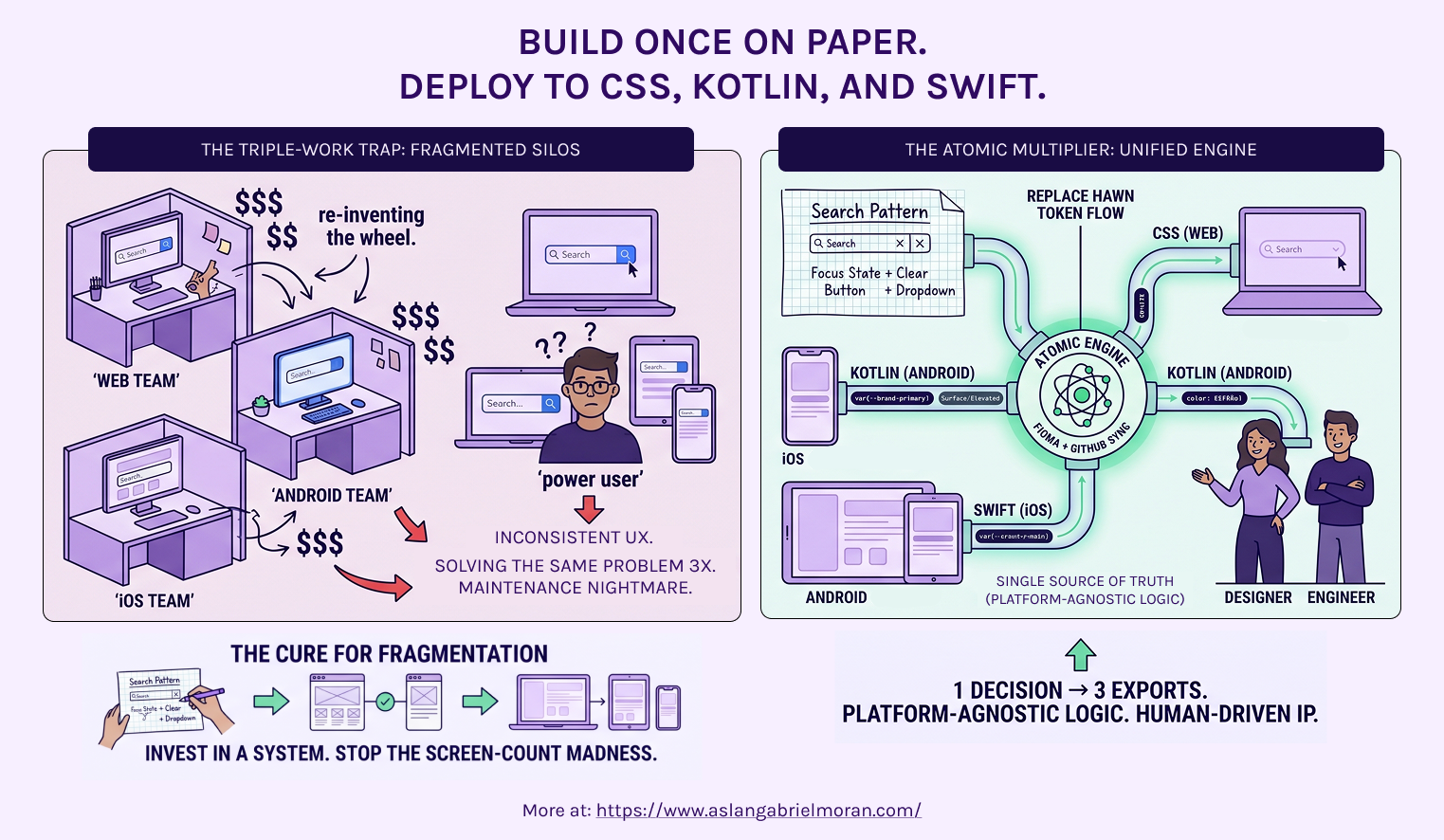
Build once on paper. Deploy to CSS, Kotlin, and Swift.
Most SaaS teams treat Web, Android, and iOS as three separate products. They hire three teams to solve the same problem three times.
This is the "Triple-Work Trap." It leads to a product that feels "mostly the same" but has subtle, irritating inconsistencies that drive your power users crazy—and your maintenance costs through the roof.
The Multiplier Effect
In our Architecture, we use the 'Atomic' Multiplier. We don't start in Figma, and we certainly don't start in the IDE. We start on paper to define the Common Logic.
If a "Search Pattern" requires a specific focus state, a clear button, and a results-dropdown behavior, that logic is platform-agnostic. By defining it at the atomic level first, we create a blueprint that feeds all three platforms simultaneously.
How the Pipeline Multiplies your Effort:
- 1 Design Decision: You decide the border-radius for all "Surface" components should be 8px for a more modern feel.
- 1 Token Update: We update the --radius-surface-m variable in the source.
- 3 Automated Exports:
- Web: Your CSS custom properties update instantly.
- Android: The Kotlin Shape object is regenerated.
- iOS: The Swift CornerRadius constants are synced.
Why "Paper-First" is your Legal Safeguard
In an era of AI-generated "noise," your IP matters. By mapping our patterns on paper before they ever hit a screen, we ensure the logic is human-driven and 100% original. This isn't a template we downloaded; it’s a custom-engineered system built specifically for your SaaS constraints.
Engineering for Longevity
We aren't building for your MVP; we’re building for the product you’ll have in three years. When you add a fourth platform (like a Desktop app or a TV interface), you don't start over. You just plug a new "pipe" into the existing Atomic engine.
Stop rebuilding the wheel for every OS. Start multiplying your output.
Ready to sync your Web, iOS, and Android workflows? Submit our Design System Intake >> form.