Hard-coded hex codes are high-interest debt.
In a scaling SaaS, "just get it out the door" is a dangerous mantra. Every time a developer manually
types #3B82F6 into a CSS file, a Kotlin object, or a Swift
constant,
they are signing a high-interest loan.
Eventually, the bank comes to collect.
The Symptom
You decide to refresh your brand or add a "Dark Mode." What should be a one-day sprint turns into a
two-week excavation. Engineers have to grep through thousands of lines of code to find every
instance of
a hard-coded value.
The Hidden Costs
- The "Guessing" Tax: Your Android dev uses Blue-500, but your Web dev uses Primary-Blue-Light. They look the same to the eye, but the
codebase is now fragmented.
- Quality Drift: "Success Green" starts looking like "Vomit Yellow" on certain
Android OLED screens because nobody accounted for platform-specific rendering.
- The Handoff Friction: Your designers spend 40% of their time "checking" if the
devs
built it right, instead of designing the next high-impact feature
The Architect’s Solution: Semantic Tokenization
We don't hand off colors; we hand off intent
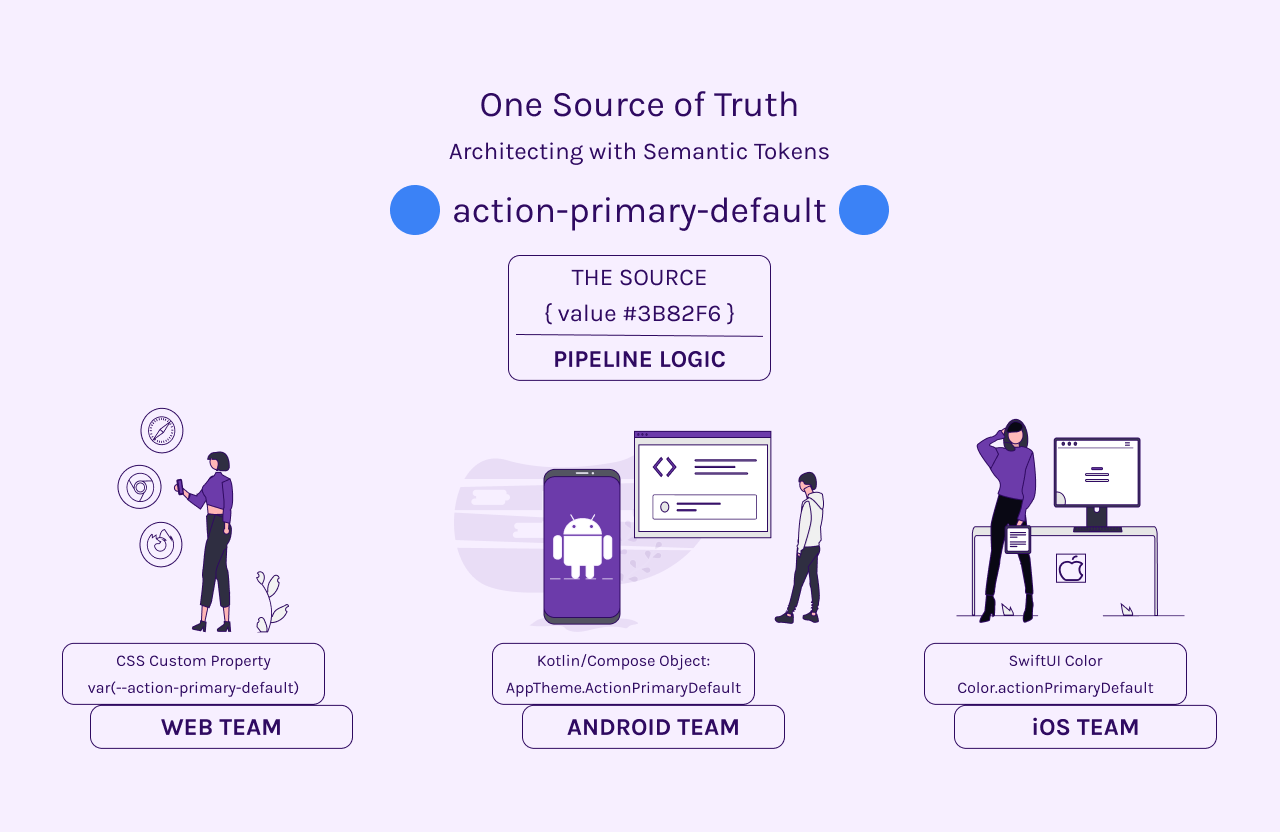
Instead of #3B82F6, your engineers receive a pipeline-driven
variable:
action-primary-default.
- For Web: It’s a CSS Custom Property.
- For Android: It’s a clean Kotlin Compose color object.
- For iOS: It’s a Swift/SwiftUI asset catalog entry.
When you change the architecture at the source, the code updates itself across all three platforms.
No
Grep. No "Guessing Tax." Just pure velocity.
Stop paying interest on visual debt. Start building on a foundation of logic.
If your frontend velocity is stalling because of manual UI syncing, let’s fix the pipeline.
One decision. Three platforms. Zero translation errors.
Ready to de-risk your UI? Submit our Design System
Intake
>> form