Professional Communication; Before Everything Goes to HELL!
This is the most critical stage of the founder journey, requiring absolute clarity before partnering with anyone. These questions are designed to uncover potential points of friction and establish an unshakable foundation for your business relationship, ensuring you proactively address the issues that inevitably lead to resentment and the breakdown of your partnership. Ask these questions now, before you move forward, to prevent everything from going to hell.
Credits: This page is highly
inspired by Marnie Jones (username: @marniejones_x) — with
her video with the description “I wish all owners checked this before going into business with
someone!”
Found at: https://www.instagram.com/reel/DWxeE0pETvr/
and the content she shares. Go follow her!
This list has been expanded based on personal experience and other
findings.
Disclaimer
This content is for informational purposes only and does not constitute legal, financial, or
professional expert advice.
Question 1
Accountability: Who is accountable for what (outcomes, not effort)?
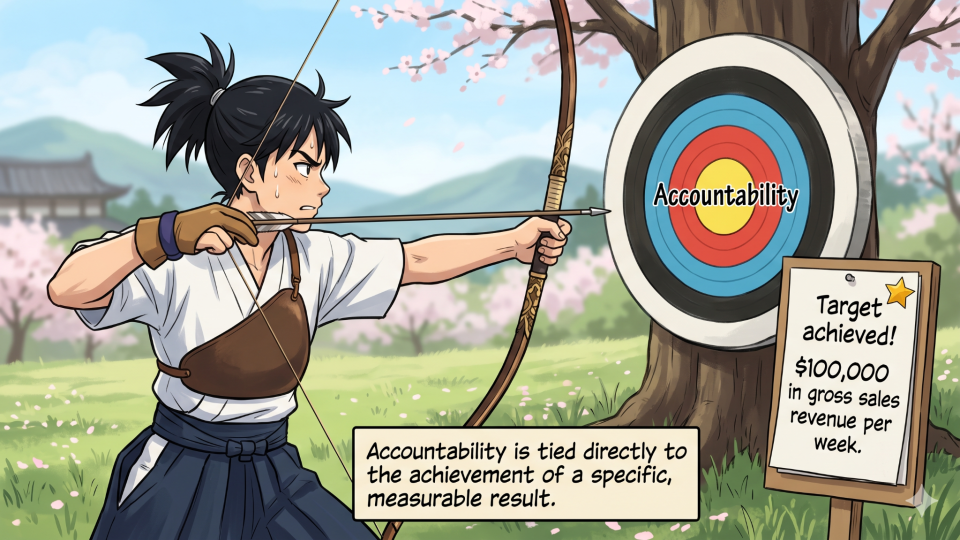
Who is truly accountable for the ultimate outcomes, and not merely the attempt or the effort expended?Accountability is the bedrock of professional communication and performance, ensuring that there is a clear owner for every result. It is fundamentally an outcome-focused discipline. The critical distinction must be drawn between effort and results. Simply "trying hard" or putting in hours does not equate to accountability. True accountability is tied directly to the achievement of a specific, measurable result.
Notes/Examples for Establishing Outcome-Based Accountability:
- Focus on the Measurable Result:
- Accountability must be quantified and time-bound. Instead of a vague intention like, "I will do sales," the commitment must be a concrete, measurable outcome: "Achieve $100,000 in gross sales revenue per week." This leaves no room for ambiguity about success or failure.
- Define the What, Not the How
- The focus should be on the objective itself. The individual is accountable for hitting the target, regardless of the precise steps they take (within ethical and legal bounds). The outcome is the target, and they own the mission to reach it.
- Avoid Process-Only Accountability:
- Holding someone accountable for "attending meetings" or "submitting reports on time" focuses on process, not impact. While processes are important, they are only valuable insofar as they contribute to the ultimate, larger outcome.
- The Buck Stops Here:
- For every critical project, metric, or initiative, there must be a single, identifiable individual who is ultimately responsible for its success or failure. When multiple people are "responsible," no one is truly accountable.
This image has been generated using Nanobana.
Question 2
Financial Clarity: Are all financial agreements super clear and agreed upfront?
Establishing crystal-clear and comprehensively documented financial agreements is not merely a formality; it is the cornerstone of a stable and enduring professional relationship, particularly in the volatile environment of a new business or partnership. Every conceivable aspect of compensation and financial stake must be meticulously outlined and mutually agreed upon before any work commences or commitments are made.
Key Areas for Definitive Upfront Agreement:
- Compensation and Salary:
- Define the exact nature and amount of regular pay, including frequency (monthly, bi-weekly, etc.), any performance-based bonuses, and the process for salary reviews or adjustments.
- Equity and Shares:
- This is often the most complex area. The agreement must explicitly detail the percentage ownership for each party, the total number of shares/units, and the corresponding voting rights.
- Vesting Schedules:
- If equity is involved, a vesting schedule must be implemented and agreed upon. This schedule dictates how and when ownership stakes are earned over time (e.g., a four-year period with a one-year cliff). This protects the partnership should a member leave prematurely.
- Profit Distribution:
- Define the mechanism and timing for how profits will be calculated, allocated, and distributed among the partners or shareholders. This should cover routine distribution as well as distributions upon significant business events.
- Capital Contributions and Draws:
- Clearly stipulate the initial capital investment required from each party, the rules governing future capital calls, and the process for partners to take periodic draws against profits or equity.
Ensuring Fairness for Every Scenario:
The true test of a financial agreement is not how well it functions when the business is thriving, but how resilient and fair it remains when subjected to extreme stress. The document must anticipate and provide specific, agreed-upon resolutions for every potential scenario the business might encounter:
- The "Hell" Scenario (Business Deterioration):
- The agreement must clearly define the financial responsibilities (e.g., covering operational losses, personal guarantees on loans) for each party when the business is performing terribly or facing insolvency. This prevents finger-pointing and financial paralysis during a crisis.
- Uneven Contribution (The "Superstar" vs. The "Slacker"):
- The framework must incorporate mechanisms to address situations where one party is demonstrably contributing significantly more or less than initially agreed upon, whether through time, resources, or performance. This might involve clauses for performance reviews, adjustment of future equity grants, or even options for one partner to buy out the other at a pre-determined valuation methodology.
- Exit and Dissolution:
- Comprehensive buyout clauses (detailing forced and voluntary exits), succession planning, and a clear process for dissolving the company and liquidating assets must be established. The methodology for valuing the business in these instances must be fixed upfront (e.g., multiple of revenue, independent valuation).
The goal of this exhaustive process is to ensure that the agreement is perceived as genuinely fair and binding, even under duress, eliminating ambiguity and protecting the foundational trust necessary for long-term collaboration.

This image has been generated using Nanobana.
Question 3
Contribution and Resentment: Will there be zero resentment about your respective contribution?
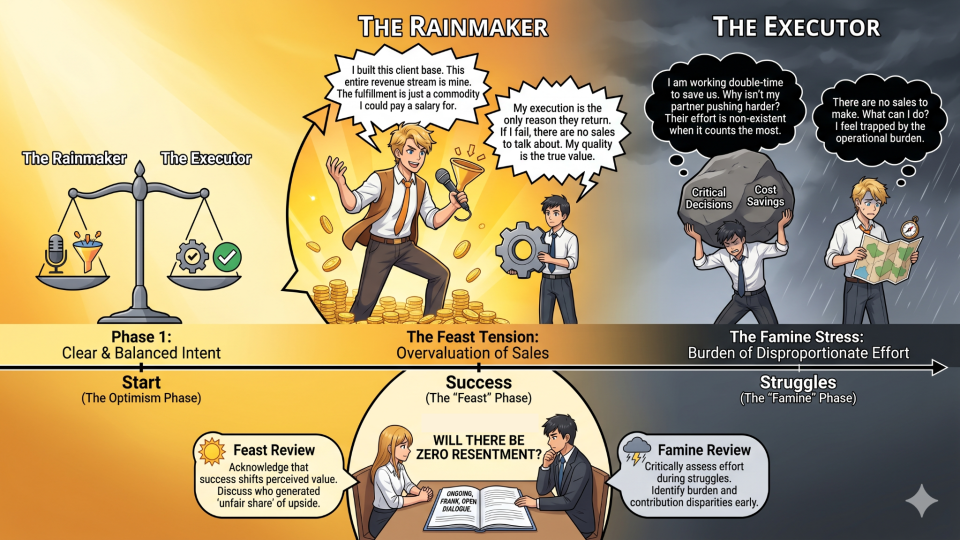
This question is a critical litmus test for the long-term viability of any partnership. While contributions may seem equal or clearly defined at the outset, the reality is that the perceived value of different contributions will fluctuate dramatically over time, particularly as the business navigates periods of both success and struggle.
The Dynamics of Perceived Value
It is imperative for partners to have a frank, proactive discussion about how contribution is valued across different roles and business cycles.
- The Sales/Marketing vs. Delivery Paradox:
- A common flashpoint arises when the person primarily responsible for sales and marketing (the "rainmaker") begins to resent the partner focused on delivery and operations. The rainmaker may feel, especially during highly successful periods ("feast"), that they are the sole engine of the business's existence. Their internal logic may become: "I built this entire client base/revenue stream. The delivery/fulfillment is a replaceable commodity. I could simply pay someone a salary to do the work instead of sharing half the business with my partner." This mindset is corrosive and must be anticipated.
- The Operations/Execution vs. Sales Paradox:
- Conversely, the partner handling may feel profound resentment during periods of high demand or operational stress. They may feel the sales partner is merely making promises the operational side must struggle to fulfill, or that the sustained quality and reputation—the very thing that makes clients return—is their sole, undervalued contribution. Their thought process might be: "If I didn't execute perfectly, the entire reputation would collapse, and there would be no sales to talk about. My contribution is the sustained value of the business."
The Test of "Feast and Famine"
A formal agreement on contribution is meaningless unless it holds up under stress—both good and bad.
- During "Feast" (High Success):
- As detailed above, success often breeds a sense of "over-contribution" in one partner. Resentment is born not from failure, but from the perception that one partner is capturing an undue share of the upside they did not earn. This is the moment when the rainmaker often feels the most powerful and, consequently, the most entitled to renegotiate the equity split.
- During "Famine" (Struggles or Downturns):
- Hard times reveal different fault lines. The partner who is perceived as generating the most immediate, measurable value (e.g., the one making a critical cost-saving decision or landing the one contract that keeps the lights on) may feel that the other partner is a burden. Furthermore, if one partner is putting in significantly more time or personal capital to weather the storm, the lack of commensurate effort from the other will instantly create resentment that can permanently fracture the trust.
To achieve the goal of "zero resentment," partners must commit to an ongoing, open dialogue.
This image has been generated using Nanobana.
Task
Define "Non-Monetary" Value
It is crucial for any organization, especially those preparing for or navigating periods of significant change (as the document's title implies), to formally define, acknowledge, and value contributions that do not result in immediate or direct revenue generation. These "Non-Monetary" Value drivers are often the foundational elements that ensure long-term stability, competitive advantage, and internal resilience.
Elaboration on Key Non-Monetary Value Categories:
- Building and Sustaining Company Culture: This encompasses the
proactive
effort to define, reinforce, and embody the
organization's core values, mission, and professional ethos.
- Value
It drives employee retention, enhances team cohesion, improves cross-departmental collaboration, and serves as a powerful recruitment tool by attracting mission-aligned talent. A strong culture reduces internal friction and accelerates decision-making by aligning priorities. - Examples:
Mentorship programs, organizing internal professional development sessions, promoting psychological safety, and consistently modeling ethical leadership behavior.
- Value
- Managing Complex Legal, Regulatory, and Financial Structures: This
area
includes the work required to ensure compliance, mitigate existential risks, and
optimize the operational framework, often far in advance of a direct financial
transaction.
- Value: It protects the company's assets, reputation, and license to operate. Proactive management in this domain prevents costly litigation, fines, and operational stoppages, effectively preserving future revenue.
- Examples: Establishing robust intellectual property protection (patents, trademarks), navigating international tax laws, ensuring GDPR/CCPA compliance, and developing internal controls to prevent fraud.
- Developing Proprietary Technology and Infrastructure: This refers
to
investment in internal systems, algorithms, unique processes, or foundational
technology
that provides a sustainable competitive edge but may not be immediately productized
or
sold.
- Value: It future-proofs the organization, creates barriers to entry for competitors, and forms the bedrock for future innovations and revenue streams. This asset represents the potential for exponential growth.
- Examples: Creating a bespoke internal data analytics platform, developing a unique machine learning model for operational efficiency, or standardizing proprietary code libraries that accelerate future product launches.
- Maintaining High-Level and Strategic Relationships (Social
Capital):
This involves cultivating and stewarding relationships with key external
stakeholders
who influence the organization's operating environment, access to capital, or market
perception.
- Value: These relationships provide early access to market intelligence, facilitate strategic partnerships, open doors to major clients or investors, and ensure support during crises (e.g., with regulators or the media). This social capital acts as a powerful strategic buffer.
- Examples: Consistent engagement with industry thought leaders, maintaining advisory relationships with government officials or regulatory bodies, and nurturing trust with major financial partners and strategic investors.
Task
Annual Contribution Review and Agreement Reassessment
Review Contribution Annually and Formally Reassess the Partnership Agreement: Do not allow the operating agreement to become a static, neglected document. The dynamic nature of business and personal development necessitates a scheduled, formal annual review process. This review is not a mere formality; it is a critical governance mechanism designed to proactively address imbalances, celebrate successes, and ensure the partnership remains fair, equitable, and aligned with current goals.
The Annual Review Process Should Include:
- Mandatory Scheduling:
- Block out a specific time each year, preferably tied to a financial or operational milestone (e.g., the end of the fiscal year or the company's anniversary), for a mandatory 'Partnership Health Check' meeting.
- Formal Contribution Assessment:
Partners must formally assess their own and each other's contributions over the past 12 months. This assessment must be rigorous and two-pronged:- Quantitative Data: Present hard metrics and verifiable data points relevant to the agreed-upon roles. Examples include:
- Sales/Revenue Generation: Closed deals, pipeline value, new client acquisitions.
- Operational Efficiency: Cost savings achieved, project completion rates, reduction in error incidence.
- Financial Input: Capital contributions, secured loans, management of key budgets.
- Time Commitment: Logged hours for specific executive functions, documented travel.
- Qualitative Feedback and Behavioral Impact: Provide specific, constructive feedback on the quality of work, adherence to core values, strategic foresight, leadership effectiveness, and overall impact on team morale and company culture. This feedback should focus on observable behaviors and their outcomes, not subjective personal attacks.
- Role and Responsibility Reaffirmation:
- Use the contribution review as the basis for reaffirming or renegotiating roles, responsibilities, and key performance indicators (KPIs) for the upcoming year. If a partner's contribution has significantly changed—either increasing due to high performance or decreasing due to external factors—the operational scope should be adjusted accordingly.
- Compensation and Equity Alignment:
- The review must feed directly into decisions regarding variable compensation (e.g., bonuses, profit share) and, if applicable and stipulated in the original agreement, discussions about potential adjustments to equity vesting schedules or ownership percentages. This ensures the reward structure remains directly tied to current performance and value provided.
- Documentation:
- All assessment data, feedback, resulting adjustments to roles, and any decisions made regarding compensation or equity must be meticulously documented and signed by all partners, forming an official addendum to the main partnership agreement. This documentation is crucial for maintaining clear expectations and providing a historical record should future disputes arise.
Establish a Mechanism for Rebalancing
Establish a Proactive Mechanism for Rebalancing Equity and Compensation
A foundational element of a sustainable partnership is an agreed-upon, objective process for addressing potential imbalances in contribution. Do not wait for unspoken resentment to build. Instead, before a significant imbalance becomes chronic and undisputed by both parties, a clear mechanism for discussion and potential rebalancing of equity, compensation, or responsibilities must be established.
This mechanism should be:
- Mandatory Scheduling:
- The process should rely on agreed-upon metrics and milestones, not subjective feelings. These metrics could include documented hours, achievement of specific business goals, capital contributions, or performance against agreed-upon key performance indicators (KPIs).
- Formalized and Scheduled:
- Do not rely on casual check-ins. Schedule a formal, periodic review (e.g., quarterly or semi-annually) specifically dedicated to assessing individual contributions against the partnership's goals and initial expectations.
- Involving a Neutral Third Party (The "Release Valve"):
- To ensure impartiality and to prevent emotional bias from derailing the discussion, the agreed-upon process should specify the involvement of an external, trusted advisor, mediator, or an agreed-upon advisory board member. This third party's role is to facilitate the discussion, ensure all data is considered fairly, and—if the parties cannot reach a consensus—provide a non-binding (or, if agreed upon in advance, binding) recommendation for rebalancing.
- Defined Outcomes and Adjustments:
The agreement must clearly outline the types of adjustments that can be triggered.
These might include:- Equity Vesting Acceleration/Deceleration: Adjusting the vesting schedule based on over- or under-performance relative to expectations.
- Compensation Revisions: Modifying salary, bonuses, or draws to reflect current contribution levels.
- Role and Responsibility Reallocation: Shifting workload or leadership duties to better align with the active partner's capacity and focus.
Establishing this "rebalancing mechanism" acts as a critical safety net, allowing the partners to address difficult topics within a structured, fair, and professional framework, thereby preventing a manageable imbalance from escalating into a partnership-ending conflict.
Operational Alignment: Are you aligned on how things should be done?
Operational Alignment: The Crucial Foundation for SuccessAre you and your team genuinely aligned on how things should be done, from the smallest task to the largest project? This level of operational alignment is one of the most critical, yet often overlooked, elements of professional communication and team cohesion. Before any major initiative is launched—and certainly before things become stressful or chaotic—it is essential to establish and agree upon a shared operational standard.
Notes/Examples:
Operational alignment is a multifaceted concept that encompasses much more than a simple set of rules. It includes establishing a clear consensus on:
- The Standard of Quality:
- What does "done" truly mean? Do team members have the same internal benchmark for acceptable quality, thoroughness, and polish in a deliverable? Misalignment here leads to rework, frustration, and inconsistent outputs that damage credibility.
- The Required Pace and Velocity:
- Are expectations clear regarding the speed at which tasks must be completed? One team member might assume a task is a full-day project, while another expects it to be finished in two hours. This discrepancy in expected pace causes bottlenecks and friction in interdependent workflows.
- The Timing and Sequencing:
- This covers the "when" of operations. It involves agreeing on specific deadlines, project milestones, and the proper sequence of steps. Clear timing ensures that dependencies are met, and that work flows logically from one stage to the next without unexpected delays.
- Resource Investment (Time and Money):
- When teams have different delivery standards, they inevitably end up clashing on what resources—both in terms of time and budget—they should be investing. A high-quality standard requires more time and possibly more expensive resources, whereas a focus on high speed might necessitate a reduction in thoroughness. Without a unified view, debates over investment become constant and unproductive, often leading to under-resourced projects or missed opportunities.
Failure to secure solid operational alignment guarantees constant clashing, inefficient processes, wasted resources, and a high likelihood of project failure. It is the bedrock upon which effective teamwork is built.
Authority and Ego: The Foundation of Functional Collaboration
Are you practically okay with the other person being in charge of their agreed-upon domain, and will you follow gladly without ego?
Effective professional communication, particularly in high-stakes environments, rests on a clear understanding and acceptance of authority. This isn't merely about organizational charts; it's a test of personal and professional maturity. The critical question is whether you can genuinely subordinate your own perspective, desires, or personal ego when another party—a partner, a team lead, or a subject matter expert—has been explicitly designated as the final decision-maker within a specific sphere of operations.Why Acceptance is Non-Negotiable: The "Two Captains" Problem
You cannot have two captains steering the ship. When two individuals try to exercise ultimate authority over the same area, the result is inevitably confusion, paralysis, or conflict. This scenario is a direct path to communication breakdown, operational inefficiency, and project failure. A successful partnership or team structure demands pre-agreed domains of control.
- Reluctantly following a decision is functionally the
same as not following it at all. It could manifest as:
- Subtle Sabotage: Rolling your eyes, expressing doubt in front of others, or delaying implementation.
- Passive-Aggressive Resistance: Implementing the decision half-heartedly, making the other person's life difficult by failing to provide necessary support or resources, or saying "I told you so" when minor setbacks occur.
- Erosion of Trust: Your hesitation signals a lack of faith in the designated authority, which breaks the fundamental trust required for collaboration.
Practical Example and Implications
For instance, are you truly okay with the partner designated as the Chief Revenue Officer (CRO) or Head of Sales and Marketing trumping any decision related to lead generation, pricing strategy, client acquisition funnels, or brand messaging?
If you are the technical lead (CTO) and fundamentally disagree with a marketing campaign's core message, your obligation is to present your data and concerns clearly before the decision is finalized. Once the CRO makes the final call within their domain, your role shifts from advisor to implementer. Your professional duty is to execute that strategy to the best of your ability, supporting the outcome as if it were your own idea. Failure to do so undermines the CRO's authority, confuses the team, and wastes resources. The moment a partner or team member senses that their authority is constantly being questioned, they will either become defensive and autocratic or simply disengage, assuming all responsibility is now contested—both leading to operational hell.
True collaboration requires the ego to step aside when the boundaries of authority have been mutually and professionally established.
Changing Circumstances: A Proactive Examination of Agreement Vulnerability
Have you considered how the agreement might fall apart when circumstances change in your respective lives?
Have you thoroughly considered and documented how your existing agreement might become untenable, or potentially collapse entirely, when significant and perhaps inevitable changes occur in your respective lives, environments, or spheres of influence? A failure to anticipate this vulnerability is a common pitfall in even the most well-intentioned professional or personal covenants.
Key Areas of Inevitable Change and Agreement Stress Points:
It is a near-certainty that various factors will exert pressure on the agreement's foundation, fundamentally changing the individuals involved and the context of your collaboration. These pressures must be openly discussed and mechanisms for adapting the agreement must be established now.
Shifting Viewpoints and Philosophy:
- The Evolution of Perspective: As individuals grow, gain new experiences, and are exposed to new information, their core beliefs, ethical standards, and strategic outlook will evolve. What one party deemed acceptable or strategically sound at the agreement's inception may later be viewed as risky, unethical, or obsolete.
- Stress Point: Divergence on the core mission, acceptable risk levels, or long-term vision.
Personal and Professional Growth:
- Skill and Status Disparity: One party may experience rapid professional growth (e.g., a major promotion, a new degree, a successful side venture), leading to a significant imbalance in power, influence, or workload capacity within the partnership.
- Changing Ambition: Goals change. A short-term collaborative effort may become a distraction when one party achieves a long-sought personal aspiration or finds a new, more compelling opportunity.
- Stress Point: Resentment due to perceived unequal contribution or the desire of one party to exit the agreement to pursue a larger endeavor.
External Pressure and Environment:
- Market and Industry Shifts: Changes in the external competitive landscape, regulatory environment, or technological advancements can render the original agreement's operating assumptions invalid.
- Personal Life Events: Major life milestones—marriage, divorce, illness, relocation, parenthood, or caring for aging family—create new demands on time, energy, and commitment that directly impact professional availability and performance.
- Stress Point: Inability to meet agreed-upon deadlines or commitments due to unforeseen external demands, requiring renegotiation of terms.
Financial Fluctuations and Incentives (Money):
- Wealth Disparity: Significant changes in the financial status of one or both parties (e.g., inheritance, investment windfall, or sudden debt/loss) can alter their reliance on the agreement's financial outcomes. A party no longer needing the income may lose motivation.
- Resource Allocation: Disputes over the equitable division of profits, new capital investment needs, or compensation structures that no longer reflect the actual value or workload of each party.
- Stress Point: Greed, perceived financial unfairness, or a loss of shared fiscal purpose that was the original glue of the arrangement.
Proactive Mitigation Strategy:
To safeguard the agreement against these inevitable stressors, the document must include:
Conflict Resolution: Establishing a Proactive Mechanism for Minimizing Disruption and Harm
What mechanism or system is in place for addressing issues with minimal conflict, pain, and upset?
The lack of a clearly defined, pre-established mechanism or system for addressing disputes and disagreements is a primary catalyst for intense, damaging conflict among business owners or partners. The question, therefore, is not if issues will arise, but what structure is firmly in place to resolve them with the absolute minimum amount of conflict, pain, emotional upset, and financial damage.
The Crucial Necessity of Pre-emptive Structuring
Arguments, resentment, and profound pain between owners almost invariably erupt precisely where these resolution systems are absent or vaguely defined. When partners embark on an endeavor, often fueled by optimism and shared vision, they frequently neglect the meticulous, and admittedly difficult, task of drafting a comprehensive exit and conflict resolution agreement. This initial oversight proves catastrophically costly.
The Paralysis of Entrenchment
The peril lies in the timing. Once the business agreement is fully executed and operational—once the venture has taken root, and time has passed—it becomes a thousand times more challenging, if not nearly impossible, to change the fundamental rules of engagement. By this point, the business structure has become inextricably linked to the partners' personal lives:
Financial Entanglements:
Substantial personal finances are committed, loans are co-signed, and personal guarantees are in place.
Asset Intermingling:
Houses, properties, and other major assets may be leveraged or financially intertwined with the business's health.
Marital and Family Stake:
The venture's success or failure directly impacts spouses, children, and entire family units, creating immense external pressure.
The Consequence: Apathy, Misery, and Stasis
The degree of courage, financial outlay, and emotional intensity required to legally challenge, negotiate a change to, or execute a complete exit from such an entrenched, flawed agreement is so overwhelming that it induces paralysis. Rather than confronting the monumental task of disentanglement—a process often likened to corporate surgery—most owners descend into a state of apathy and chronic misery. They actively choose to maintain the dysfunctional status quo, enduring the pain and resentment day after day, because the perceived cost of disruption is simply too intense. This stasis ensures the ongoing toxicity of the relationship and the eventual decay of the business itself, guaranteeing a painful, slow-motion catastrophe instead of a single, decisive moment of resolution.